AI creates new opportunities for Chartered Accountants
Artificial intelligence is creating new opportunities for Chartered Accountants to spend more time on insight, strategic advice and better decisions, according to new global research from Chartered Accountants Worldwide (CAW) and Ipsos.
The study of nearly 3,000 members and students from 12 CAW member institutes found that 83 per cent of working Chartered Accountants surveyed use AI at least weekly, including 41 per cent who use it daily. Most say AI is enhancing their work (85 per cent) and having a positive impact on their role (82 per cent).
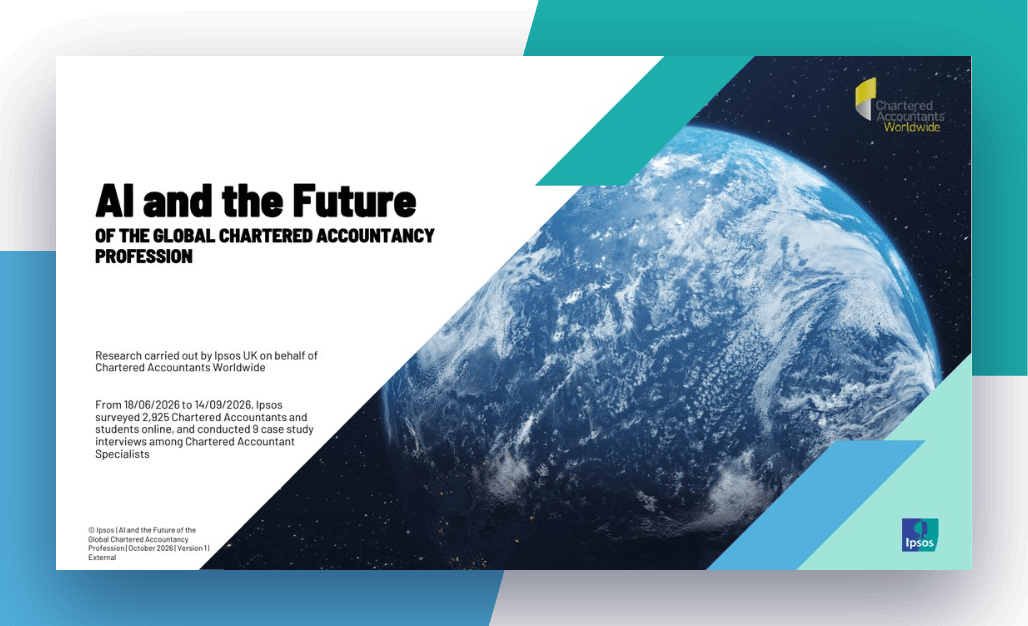
The Story in Brief
AI is transforming Chartered Accountancy. Most Chartered Accountants surveyed now use it as an everyday part of their work, and the large majority say it enhances what they do and has a positive impact on their role.
Training is associated with stronger outcomes, with 43 per cent having received training through their organisation. Trained respondents are more likely than those without training to say AI improves effectiveness and efficiency (67 per cent compared with 55 per cent), helps them add value to business and clients (45 per cent compared with 32 per cent), and that their organisation’s governance meets professional standards (74 per cent compared with 47 per cent).
The findings point to a clear role for Chartered Accountancy bodies: more training and support, especially for new entrants; work with employers to rethink the early careers model; and practical, accountancy-specific guidance on governance and ethics.

Use is everyday, advanced use is rare.
Fewer than 2 in 10 use agentic AI.

Training is the multiplier.
67% of trained users say AI helps them work more efficiently, compared with 55% of those without training.

Governance is following use, not leading it.
Members want practical, accountancy-specific guidance from their professional body.
Key findings
Six findings from the 2026 study: three on the difference AI is already making, and three on how the profession can build on it.
.
-
83%
use AI at least weekly
AI is now part of everyday work
-
85%
say AI is enhancing what they do
AI is enhancing the role of the Chartered Accountant
-
44%
are spending more time turning data into business decisions
Time saved is going into insight and advice
-
71%
rate critical thinking as very important in the age of AI
Judgement is the skill that matters most
-
67%
of those with AI training say it makes them more effective and efficient
Training is associated with stronger outcomes
-
57%
are confident their organisation’s AI governance meets professional standards
Clear rules can unlock greater value
Source: AI and the Future of the Global Chartered Accountancy Profession, Ipsos UK for Chartered Accountants Worldwide, 2026.
“AI is an enormous opportunity for our profession. As it takes on more routine work, it gives Chartered Accountants greater scope to interpret information, challenge assumptions and more quickly provide the strategic advice organisations need.”
“What will set Chartered Accountants apart is their judgement, professional scepticism, ethics and accountability, not just their ability to use AI. These are the skills that turn AI’s fast outputs into better decisions.”
Ainslie van Onselen
Chair of Chartered Accountants Worldwide and CEO of Chartered Accountants Australia and New Zealand
Roles, skills and governance: a closer look
This year’s study focused on three themes chosen by CAW’s AI Working Group.
.
Roles
More time for insight and strategic advice
As AI takes on routine tasks, Chartered Accountants are reinvesting the time they save in higher-value work. Among those already using agentic AI, 67% say AI will lead to opportunities.
Skills
Human judgement turns AI outputs into better decisions
Critical thinking and professional scepticism are most often rated very important in the age of AI, alongside data privacy, ethics and understanding AI’s limitations. Effective prompting ranks lower, at 47%.
Governance
Chartered Accountants can lead on responsible AI
Over half are confident their organisation’s AI governance meets professional standards. Chartered Accountants’ expertise in assurance, ethics, risk and governance positions them to help organisations put clear rules into practice.
Training is the multiplier
43% of respondents have received AI training through their organisation. They are more likely than those without training to say AI improves their effectiveness and efficiency, helps them add value for their business and clients, and that their organisation’s governance meets professional standards.
Members look first to their professional body for support: 60% expect professional accountancy bodies to provide AI training, more than any other source.
With and without AI training through their organisation
“AI is already helping me to work more effectively and efficiently”
“AI is already helping me to add value to my business and clients”
“Confident their organisation’s approach to AI governance meets professional standards”
Base: 998 who have had AI training through their organisation and 1,046 who have not.
What Chartered Accountants want from their professional body
Professional accountancy bodies are the most expected source of AI training (60%), well ahead of employers (25%). Asked what they would value most from their body, members chose:
-
42%
Specialised AI training courses and certifications
-
41%
Best practice guidance on AI use, specific to accountancy
-
37%
Access to AI learning resources and tools
-
36%
Ethical guidelines and standards for the use of AI in accounting
Base: 1,699 respondents who expect their professional body to play a role in supporting members on AI. Respondents chose their top three.
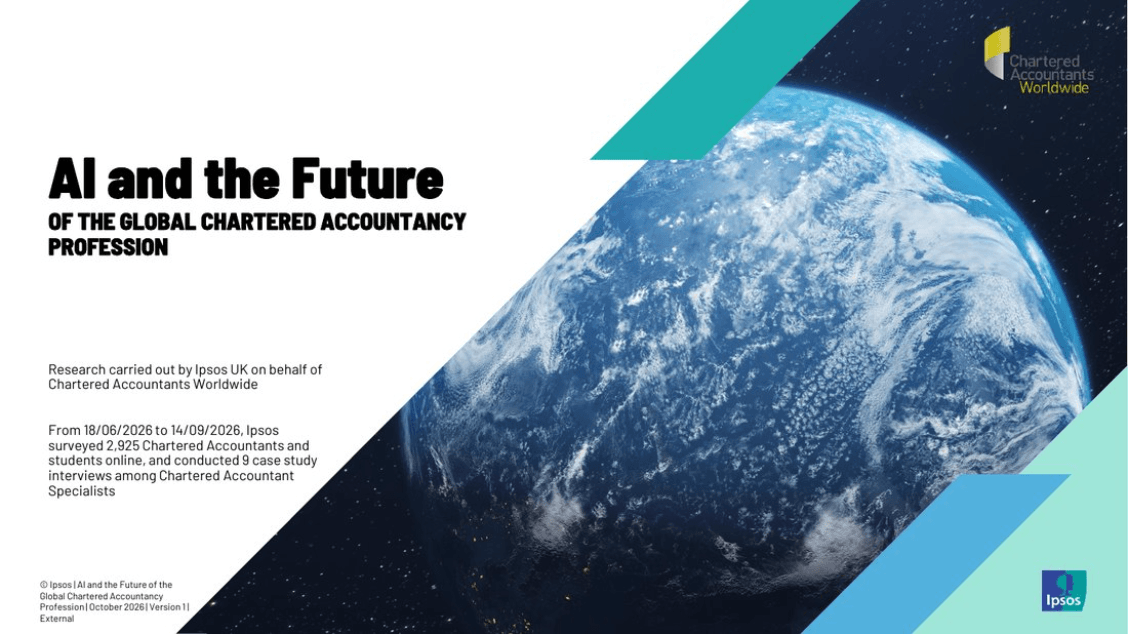
Download the full report
AI and the Future of the Global Chartered Accountancy Profession sets out the full 2026 findings on AI adoption, roles, skills and governance, with detailed charts, comparisons between groups and insight from in-depth interviews.
About the research
Ipsos UK carried out the research on behalf of Chartered Accountants Worldwide, which represents over 2 million Chartered Accountants and students globally. A 20-minute online survey ran from 18 June to 14 September 2026 and was completed by 2,925 respondents across 12 CAW member institutes. Ipsos UK then held nine in-depth interviews with survey respondents and members of CAW’s AI Working Group.
Quotas were not applied, so the results are indicative of those who responded rather than representative of the profession as a whole. Members who are retired and no longer professionally active are excluded from the analysis. Some questions were not asked in the separate Australia and New Zealand fieldwork, and base sizes vary by question.
This is the second wave of the study. Because so much has changed since 2024, the 2026 results are presented as a fresh benchmark rather than as a trend.
Participating member institutes
BICA (Botswana)
CAI (Ireland)
ICAEW (England and Wales)
ICAN (Nepal)
ICAS (Scotland)
SAICA (South Africa)
CA ANZ (Australia and New Zealand)
IAI (Indonesia)
ICAI (India)
ICAP (Pakistan)
ISCA (Singapore)
ZICA (Zambia)