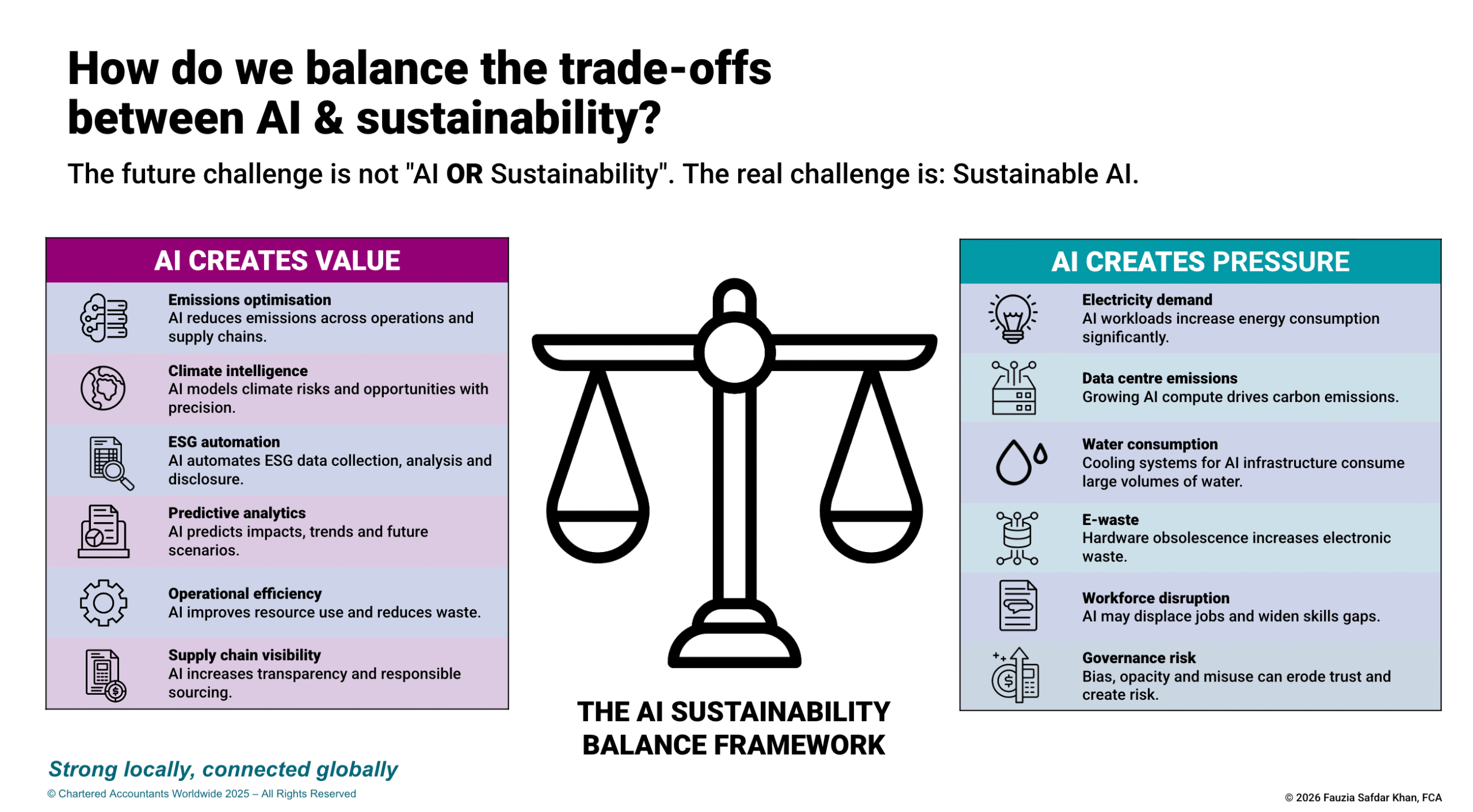
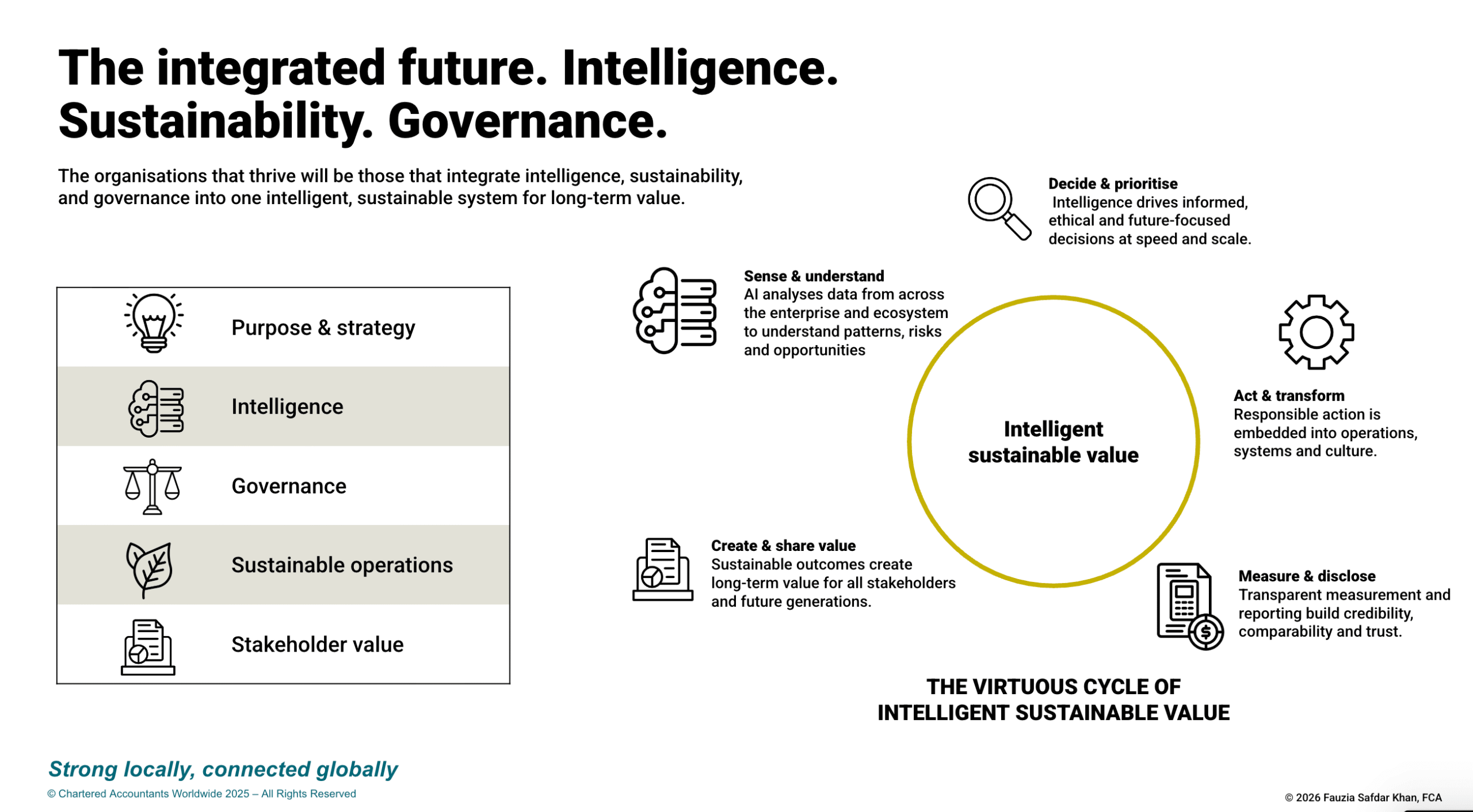
AI is already creating significant opportunities for organisations. It is improving operational efficiency, strengthening risk analysis, accelerating reporting processes and generating insights at a scale that would have been difficult to imagine only a few years ago.
For example, AI can analyse large volumes of business and sustainability data to identify emerging risks that might otherwise go unnoticed. It enables management to respond more quickly and make better-informed decisions. But as AI becomes more deeply embedded in those decisions, accountability does not shift to technology. It remains with the people responsible for making and approving them.
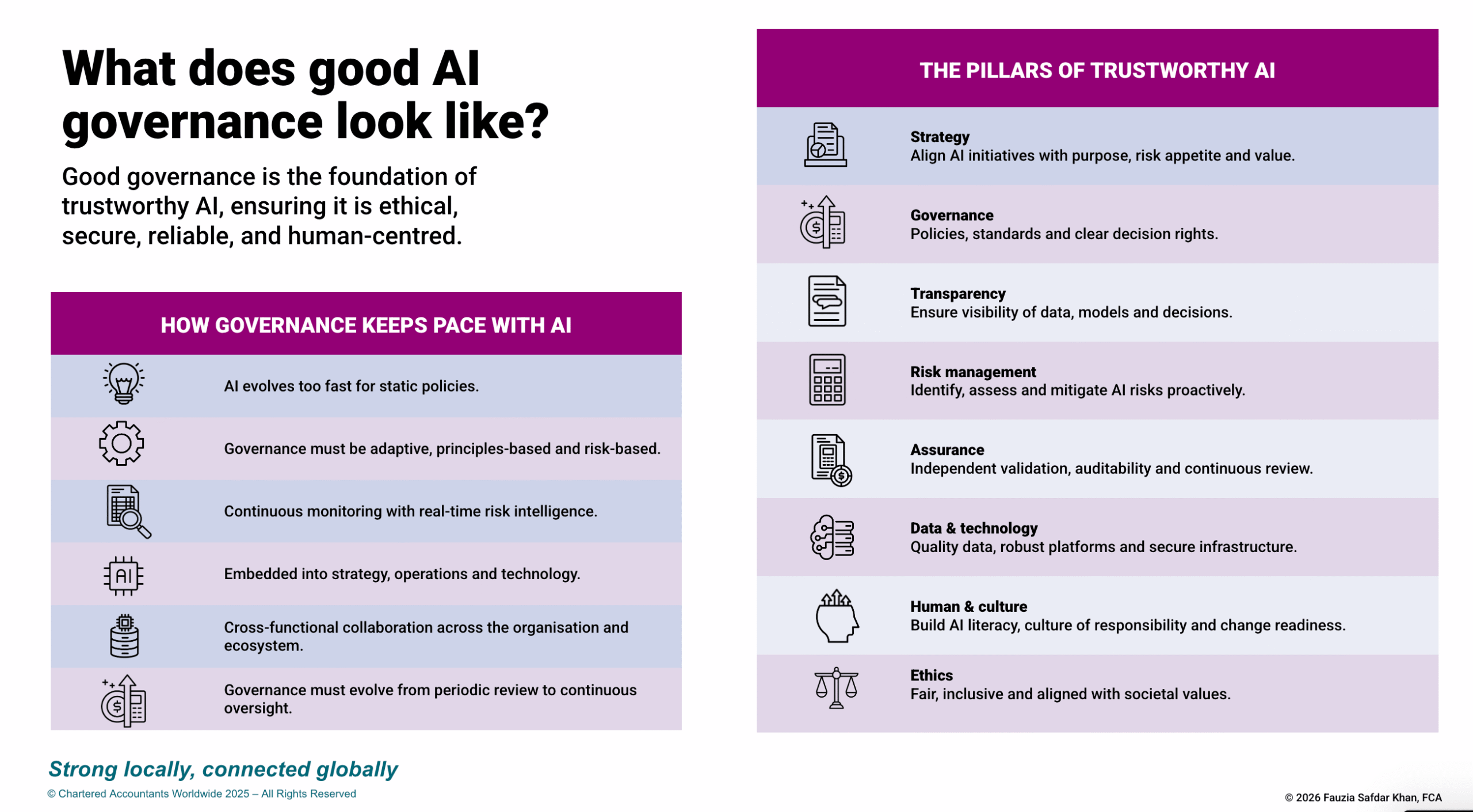
Every opportunity created by AI brings a corresponding responsibility. Faster reporting creates value only when the underlying information is reliable. Better insights matter only when they can be understood, challenged and trusted. And while automation can improve efficiency, it does not remove accountability. If anything, it makes effective governance and human oversight even more important.
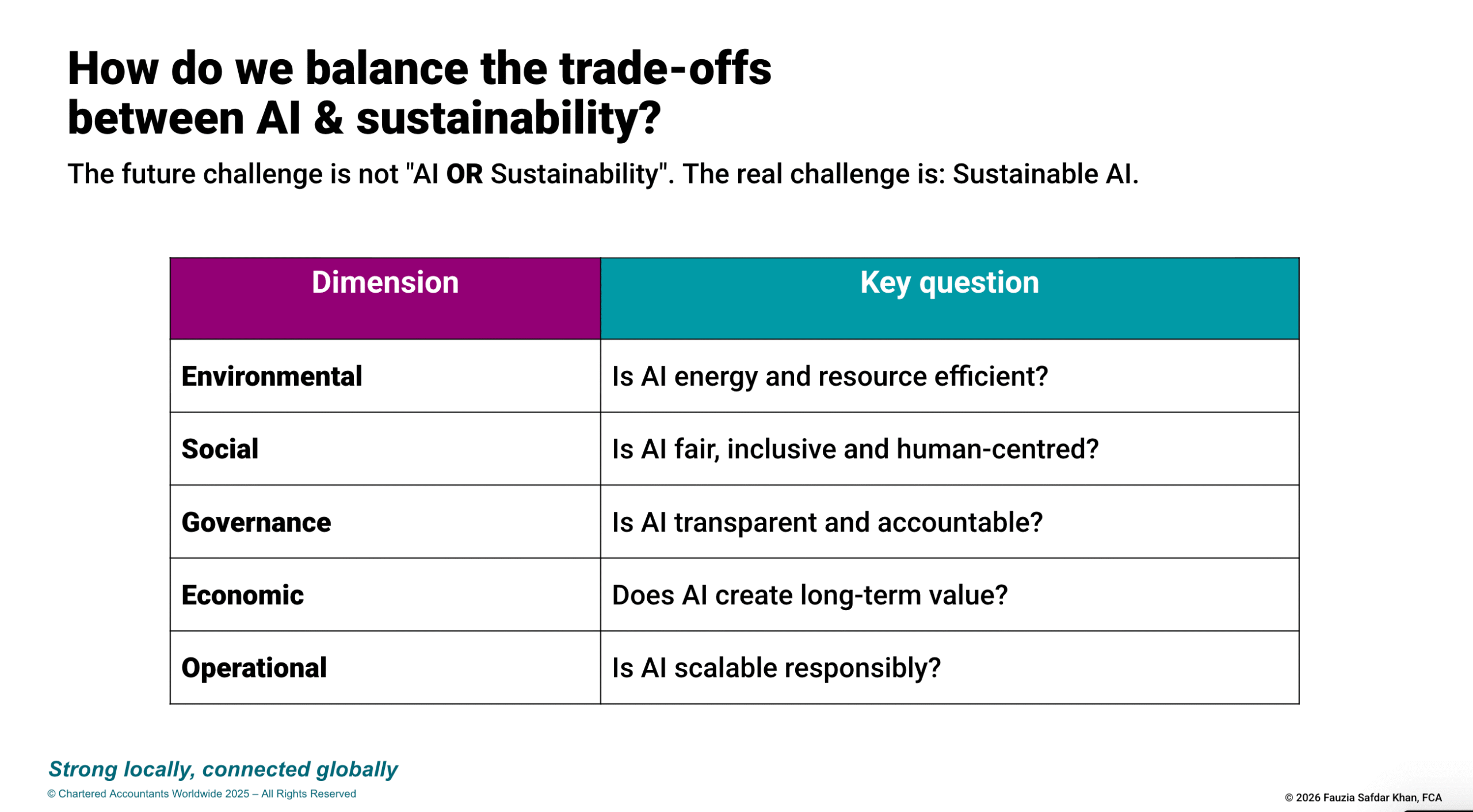
This is particularly important in sustainability, where organisations must balance environmental, social and economic priorities while responding to the expectations of investors, regulators, customers and other stakeholders. AI can support these decisions, but it cannot replace the professional judgement required to make them.
The objective is not to choose between innovation and responsibility, but to ensure they develop together. Responsible AI is not about slowing progress. It is about making sure innovation remains transparent, accountable and focused on creating long-term value.
Successfully navigating these trade-offs requires technical knowledge, sound governance and professional judgement. These are capabilities that place the Chartered Accountancy profession at the centre of this evolving landscape.
The Chartered Accountancy profession’s opportunity
For Chartered Accountants, the convergence of AI, sustainability and governance represents far more than a new reporting challenge. It presents an opportunity to help shape the way organisations create, measure and communicate value in an increasingly complex business environment.
For decades, the profession has played a critical role in building confidence in financial information through assurance, governance, risk management and accountability. Those same strengths are becoming even more relevant as organisations seek to navigate the opportunities and risks associated with AI-enabled decision-making and sustainability-related disclosures.
As sustainability disclosures, AI-enabled processes and digital reporting ecosystems become more interconnected, expectations of assurance will continue to evolve. Confidence in AI-generated outputs will depend not only on technology, but also on the controls, governance arrangements and assurance mechanisms that support it.
The role of the Chartered Accountant is expanding beyond financial reporting. As AI becomes embedded within organisational processes, the profession will increasingly contribute to the oversight of AI-enabled systems, sustainability disclosures and the governance structures that support them.
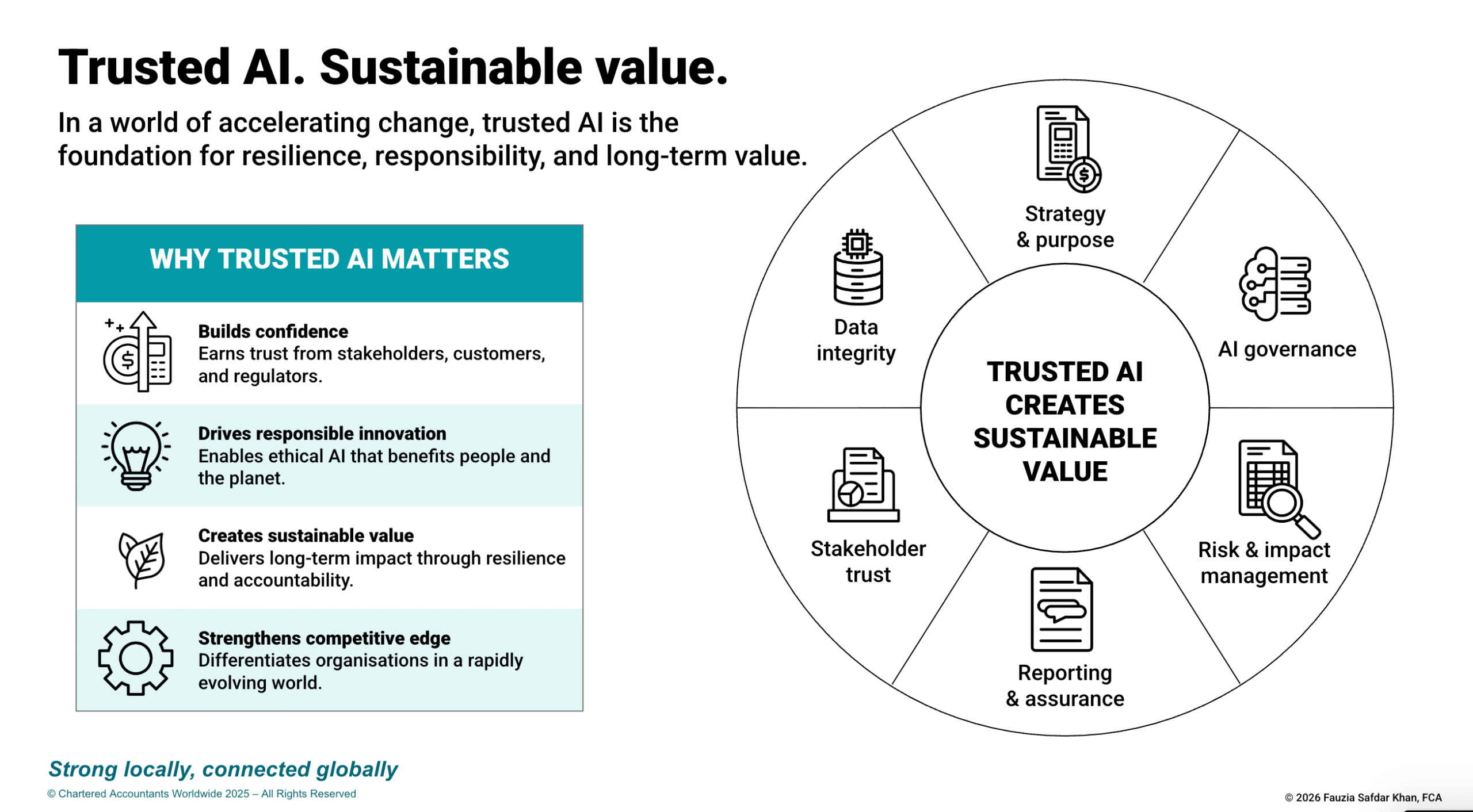
In an environment where trust has become a strategic asset, the profession’s greatest contribution may be its ability to combine technical expertise with independent judgement, helping organisations make decisions that are credible, transparent and capable of withstanding stakeholder scrutiny.
This shift is already visible in the way leading organisations are applying AI to strengthen sustainability reporting, governance and decision-making.
Learning from leading organisations
While much of the discussion around artificial intelligence continues to focus on future possibilities, leading organisations are already demonstrating what responsible AI looks like in practice. Although their approaches differ, they share one common characteristic: AI is creating the greatest value where it is supported by strong governance and aligned with sustainability objectives.
Unilever, which operates in more than 190 countries, has developed an internal AI chatbot using Microsoft Copilot Studio to improve the efficiency and consistency of sustainability reporting. Rather than searching the internet, the solution draws information exclusively from a curated knowledge base of company-approved sustainability reports, regulatory guidance and internal documentation, with every response linked to its original source for verification.
The chatbot supports teams responding to increasingly complex sustainability information requests, including customer questionnaires containing more than 100 questions on topics such as Scope 3 emissions and the EU Deforestation Regulation (EUDR). Rather than spending time searching for information, sustainability professionals can focus on reviewing, validating and interpreting it, while management retains responsibility for approving all externally reported information. The result is greater reporting efficiency without compromising governance, accountability or professional judgement.
A different perspective is provided by Banco do Brasil, one of Latin America’s largest financial institutions, serving more than 80 million customers. As AI became increasingly embedded across critical banking operations, the bank recognised that technology alone was not enough. AI also required governance capable of ensuring that decisions remained transparent, explainable and accountable. It therefore established an enterprise-wide AI governance framework with clearly defined accountability, structured pre-deployment risk assessments, continuous monitoring of model performance, bias and transparency, and comprehensive audit trails to support regulatory oversight. This governance-first approach has enabled Banco do Brasil to scale AI adoption with greater confidence while strengthening regulatory compliance, organisational oversight and stakeholder trust.
Beyond these individual examples, a broader pattern is emerging across leading multinational organisations. Leading organisations are moving away from treating AI as a standalone technology initiative and are instead embedding it within existing corporate governance, risk management and sustainability structures. Organisations such as BASF, Novo Nordisk, SAP and Telefónica have introduced Responsible AI principles, strengthened data governance and embedded human oversight into the design, deployment and monitoring of AI systems. Although their approaches differ, they reflect a common evolution in corporate practice: AI is increasingly being managed as a strategic organisational capability requiring governance disciplines comparable to those applied to financial reporting, cybersecurity and enterprise risk management.
Taken together, these examples point to an important conclusion. The organisations creating the greatest long-term value from AI are not necessarily those deploying the most advanced technology. They are those combining innovation with trusted data, effective governance and informed professional judgement. As AI becomes more deeply embedded in sustainability reporting, operational decision-making and corporate strategy, this integrated approach is rapidly becoming a hallmark of leading practice.
Preparing for a machine-readable future
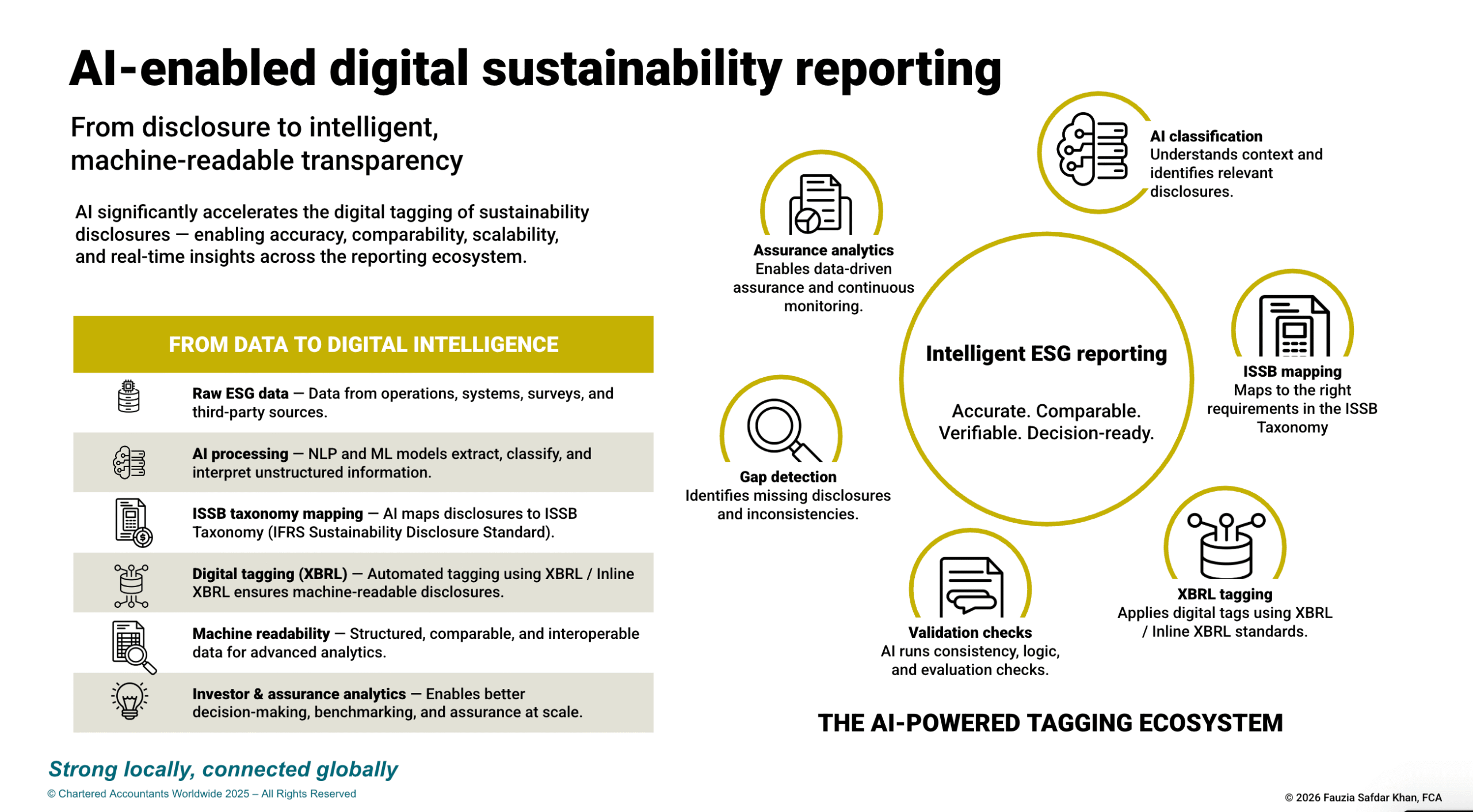
The impact of AI extends well beyond operational decision-making. It is also beginning to reshape the way organisations collect, structure and communicate information
For decades, corporate reports have been designed primarily for human readers. Increasingly, however, sustainability and financial information will also be consumed by machines.
Digital reporting frameworks such as XBRL and emerging sustainability taxonomies are expected to play a central role in this transition. AI can help organisations map disclosures to reporting taxonomies, automate digital tagging, identify reporting gaps and improve the consistency and quality of information before it is published.
The future sustainability report may increasingly be read by machines before it is read by humans.
This means that the quality of underlying data, digital reporting processes and governance arrangements will become just as important as the disclosures themselves.
This is more than a change in reporting formats. It represents a fundamental shift towards a connected, transparent and digitally enabled reporting ecosystem.
Technology alone will not deliver this transformation. Its success will depend on reliable data, effective governance and organisations that are ready to rethink not only how they report information, but how that information is created, managed and trusted
Start with purpose, not technology
One of the most common mistakes organisations make when adopting AI is treating it primarily as a technology initiative.
Successful AI adoption rarely begins with technology. It begins with a clear understanding of the outcomes an organisation is trying to achieve and the value it wants to create.
Organisations that begin with technology rather than purpose often struggle to realise sustainable outcomes. Those making the greatest progress start by understanding their strategic priorities, business challenges and stakeholder needs before deciding where AI can genuinely add value.
AI is not a strategy.
It is an enabler.
Its value depends on how effectively it strengthens decisions, supports organisational objectives and contributes to long-term value creation.
Ultimately, successful AI adoption is not measured by how much technology an organisation deploys, but by whether that technology helps people make better decisions and create lasting value. Organisations that begin with purpose are far more likely to earn the confidence of those they serve
Trust will define the future