

Artificial Intelligence and trust in the Chartered Accountancy profession

Loading the Elevenlabs Text to Speech AudioNative Player...

Summary

This paper gives high-level considerations and prompts to help Chartered Accountants and those responsible for governance think about the basics: where AI is being used, the potential implications for trust, and the key questions to consider when adopting or overseeing AI-enabled activities.

AI is increasingly embedded across reporting, audit and assurance, governance, analysis and advisory services.
Used appropriately, it can enhance efficiency, insight and quality. However, without appropriate understanding, oversight and professional judgement, AI may introduce risks that affect both individual engagements and broader confidence in the profession.

The paper is intended to support awareness and consistent thinking about key professional considerations related to AI, regardless of how the technology is
deployed, i.e. through agents, chatbots, analysis GenAI etc. This document is not intended to be a technical guide, or a substitute for professional judgement, organisational policies, legal or specialist advice or applicable standards.

This paper highlights five core messages:
1. Human accountability remains fundamental.

Responsibility for professional work always rests with the Chartered Accountant. Ethical obligations, judgement and accountability cannot be delegated to AI systems, models or vendors.

2. Professional scepticism is critical in an AI-enabled environment.

AI outputs may appear authoritative while being incorrect, biased or incomplete. Maintaining professional scepticism and exercising independent judgement are essential to preserving quality and credibility.

3. AI introduces distinct and amplified trust risks.

AI can amplify existing risks and introduce new ones, including accountability gaps, limited explainability, regulatory non-compliance and reputational impacts. These risks evolve as AI use matures.

4. Strong governance underpins responsible AI use.

AI adoption is a governance and ethics issue, not only a technology decision. Clear policies, defined boundaries, documented controls and accountability are essential.

5. Cybersecurity and transparency are essential enablers of trust.

AI tools depend on data, access and connectivity. Weak cybersecurity controls and unclear data handling practices can quickly undermine confidentiality, privacy and
professional trust.

In summary, while AI presents opportunities to enhance professional practice, it does not replace the judgement, scepticism and ethical responsibilities of Chartered Accountants. The questions included in this paper are intended as prompts to support reflection, risk awareness and sound decision-making as AI continues to evolve.

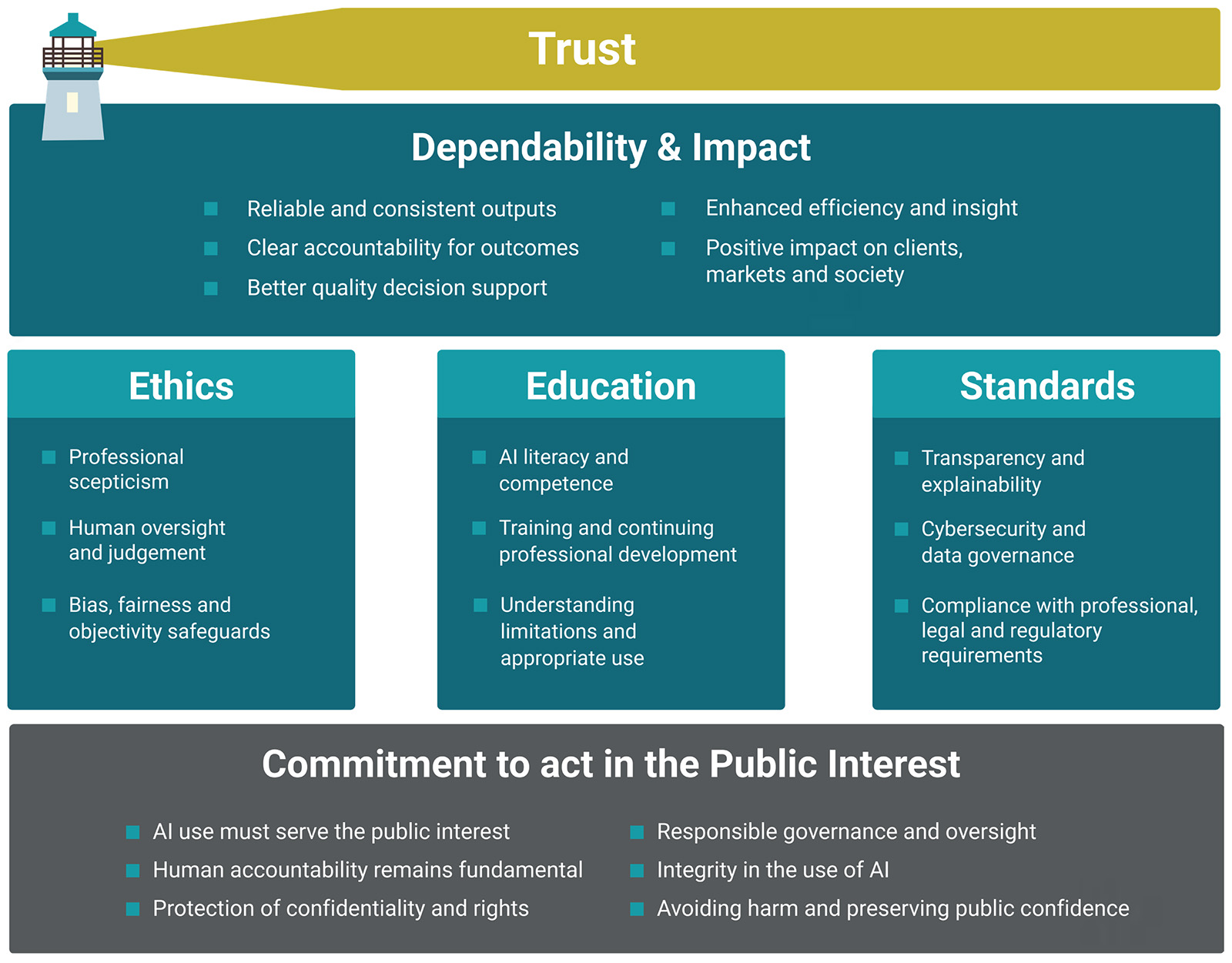
Trust and AI Inforgraphic

The enduring importance of trust in Chartered Accountancy

Trust has always been central to the Chartered Accountancy profession. As set out in Trust: Making the Difference, that trust rests on enduring foundations: a commitment to act in the public interest, rigorous ethics, high standards of education and competence, and accountability through oversight and discipline. Artificial intelligence (AI) does not change these foundations—but it does change how they must be applied in practice. AI is already reshaping how information is generated, analysed and communicated. For Chartered Accountants, this creates opportunities to enhance quality, insight and efficiency across financial and non-financial reporting, assurance, governance and decision-making. At the same time, AI introduces new risks to trust if it is used without appropriate understanding, governance or professional judgement.

Human accountability in the age of AI

At the heart of our profession is trust — and that trust has always been grounded in human accountability. No matter how information is prepared or what tools are used along the way, it is the professional accountant who stands behind it. The responsibility for its integrity, accuracy and appropriateness cannot be delegated to a process or a platform.

This is why the rise of AI and advanced analytics doesn’t make the accountant’s role less important — it makes it more so. The judgement, scepticism and ethical grounding that define good practice are needed now just as much as ever, perhaps more.

The evolving role of Chartered Accountants

Chartered Accountants are data guardians, ethical navigators and trusted voices on technology adoption. At the same time, AI tools are now widely available and many are genuinely useful — capable of processing large volumes of data, identifying patterns, drafting documents and supporting complex analysis at scale.

Maintaining trust while embracing AI

The question is not whether Chartered Accountants should use AI. Many already do, and many more will. The question is whether they are using it in a way that preserves and enhances the trust that the profession has earned.

This paper provides a structured framework of questions and considerations for individual Chartered Accountants, professional bodies and accountancy firms as they plan, implement and govern the use of AI in their work.

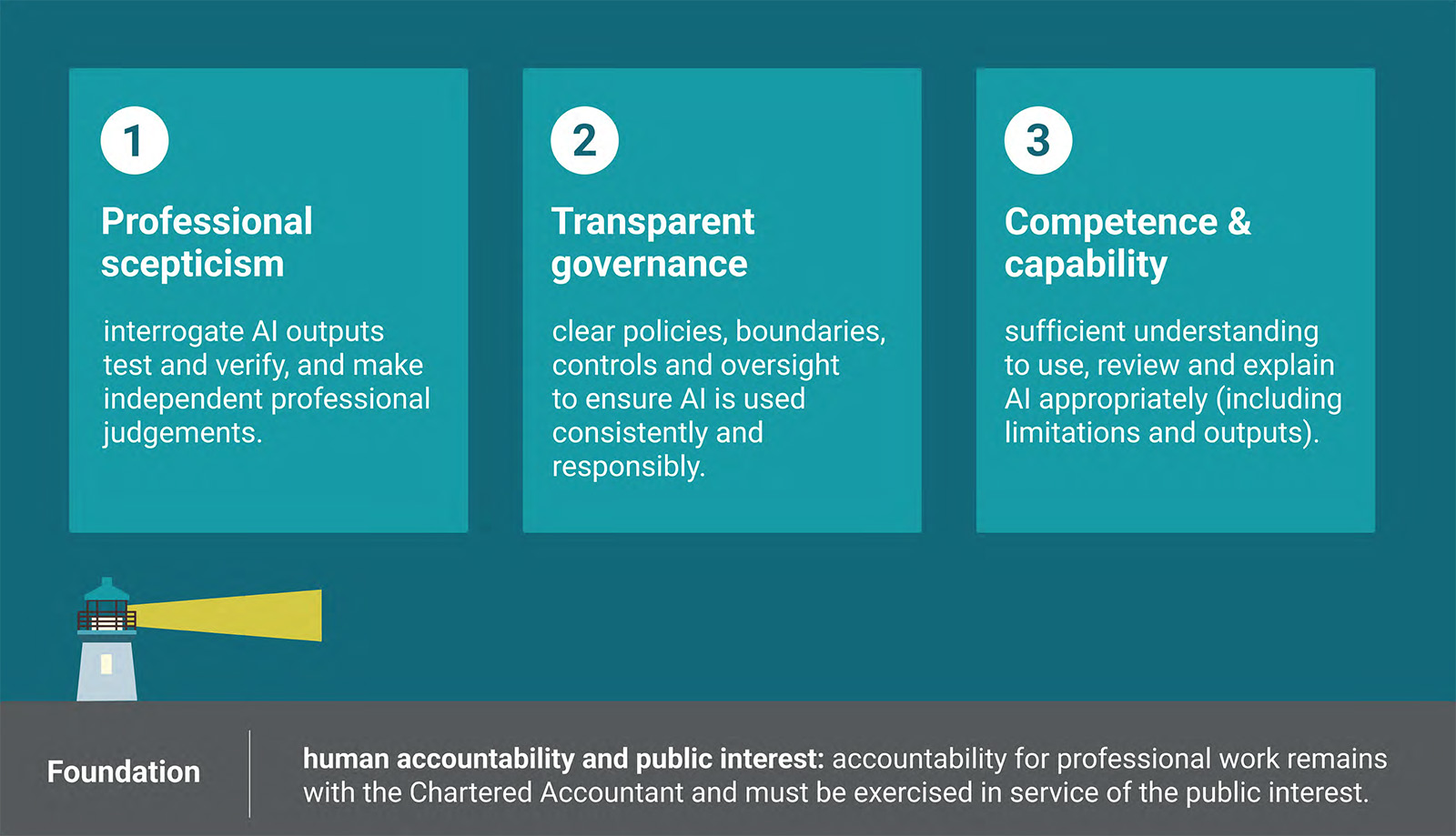
Three pillars of trust in the AI era

Three pillars of trust in the AI era

Navigating emerging risks and challenges in the age of GenAI

Risk Area: Automation bias and over-reliance

Uncritically accepting AI-generated reports and findings poses a real risk of attributing errors directly to the technology. This can lead people to depend too much on AI, overlooking their own critical thinking and professional judgement. As a result, accountability decreases, and mistakes are less likely to be questioned.

Risk Area: Data privacy and confidentiality

Feeding sensitive client or employer data into AI tools without understanding how that data is stored, processed or used is a critical risk that Chartered Accountants must be aware of, as it can expose organisations to legal, regulatory, and reputational consequences.

Risk Area: Decline in professional scepticism

The adoption of GenAI has the potential to impact human autonomy significantly. As individuals and professionals increasingly rely on algorithm-driven tools for decision-making, there is a risk that their independence may be diminished. This growing dependence on AI can lead to a gradual erosion of critical thinking skills, where practitioners become less inclined or able to challenge or scrutinise outputs generated by these technologies. With regular use, AI may shape behaviours and attitudes, reducing the willingness to question results and potentially undermining professional scepticism.

Risk Area: Accountability gaps

GenAI raises major questions about responsibility and ownership when harmful outcomes occur. It is unclear whether users or developers should be held accountable, and there is ongoing debate over who owns AI-generated work. This lack of clarity makes it hard to assign accountability or effectively address errors and ethical issues.

Risk Area: Regulatory non-compliance

Using AI tools that fail to meet legal or regulatory standards can lead to fines, restrictions, and increased management attention. System features may also heighten associated risks and harms.

Risk Area: Reputational damage

Public disclosure of an AI error that was not caught by professional review, undermining stakeholder trust.

Risk Area: Objectivity, bias and fairness

Objectivity requires professionals to be alert to bias and to avoid undue influence on professional judgements. AI can reproduce or amplify bias present in training data, prompts, assumptions, or underlying models—leading to skewed outputs and unfair outcomes. This risk is particularly acute where AI is used to classify, prioritise, predict, or recommend actions that affect stakeholders. This is distinct from automation bias, which relates to human over reliance on AI outputs. Even where outputs appear reasonable, hidden bias can undermine neutrality and public confidence. Judgements informed by AI therefore need to be evaluated for balance, fairness and alignment with stakeholder interests.

Risk Area: Lack of explainability and transparency

As AI systems become more complex, it may be difficult to explain how an output was generated or which factors drove a result (the “black box” problem). Limited explainability can constrain professional review, reduce defensibility of decisions, and create challenges in audit, assurance and compliance contexts—particularly where stakeholders expect clear rationale, evidence and traceability. The International Code of Ethics for Professional Accountants (International Code of Ethics) focuses on understanding and avoiding undue reliance on technology, including inputs, data, related decisions and other key factors.

Risk Area: Transparency failures

Failing to disclose to clients or stakeholders that AI was used in producing advice or reports undermines transparency and accountability.

Risk Area: Operational and cyber risks

I can create operational disruption through outages, degraded performance, integration issues and third party dependency (including model/service changes). It can also increase cyber exposure where tools connect to internal systems or handle sensitive information (e.g., compromised credentials, unauthorised access, data exfiltration, prompt injection).

Risk Area: Financial risks

There is a financial risk that the investment in GenAI tools and training may not be justified by the potential long-term benefits.

Questions to support trust when using AI

This list of key questions is designed to prompt thinking and support consistent, ethical and trustworthy use of AI by Chartered Accountants and their organisations. This is not intended as a check list but a starting point for thinking about the professional considerations involved in adopting AI.

AI and professional ethics

AI does not change the ethical foundations of the profession. Accountability for professional work always rests with the Chartered Accountant, not the tool.

  • Does the organisation’s use of AI align with the fundamental principles of the International Code of Ethics (integrity, objectivity, professional competence and due care, confidentiality, and professional behaviour)?
  • Does the organisation’s use of AI align with the technology provisions within the International Code of Ethics?
  • Is it clear that responsibility for AI‑assisted work remains with a human professional?
  • Does the organisation explicitly recognise that AI must serve, not undermine, the public interest?

Key AI risk areas

AI introduces new and amplified risks that can affect trust, compliance and professional judgement.

Has the organisation identified and documented key AI‑related risks, including:

  • automation bias and over‑reliance
  • data privacy and confidentiality breaches
  • reduced professional scepticism
  • accountability gaps
  • regulatory non‑compliance
  • reputational damage
  • bias, objectivity and fairness
  • operational, cybersecurity and financial risks?

Are these risks reviewed regularly as AI tools and use cases evolve?

Planning and readiness

Different AI tools pose different levels of risk depending on how they work, what data they use, and how outputs are generated.

  • Has the organisation undertaken basic due diligence on how each AI tool operates and its intended purpose?
  • Is the proposed use of AI appropriate given the level of judgement involved?
  • Are the limitations, known weaknesses and error risks of the tool documented?
  • Has the organisation confirmed compliance with applicable data protection and privacy laws in all relevant jurisdictions?
  • Has the organisation assessed intellectual property considerations (e.g., ownership, licensing and permitted reuse of inputs and outputs) for the proposed AI use?
  • Are only approved and enterprise grade tools used for professional work involving confidential information?

Defining scope and appropriate use

  • Has the organisation clearly defined which tasks may use AI support and which must remain fully human led?
  • Has the organisation assessed its overall AI readiness (data quality, systems, skills and governance)?
  • Would the organisation be comfortable explaining and defending its AI use to regulators, clients or the public?
  • Is AI adoption aligned with broader organisational strategy and objectives?

Implementation and day to day use

Many AI risks arise at the point of use rather than during planning.

  • Has the organisation clearly articulated the business purpose and objectives for each AI use case?
  • Have relevant stakeholders been engaged, including risk, compliance, IT and professional leaders?
  • Are responsibilities for AI-assisted work clearly assigned?

Professional judgement, scepticism and quality control

AI outputs can appear plausible while being incorrect. Professional scepticism remains essential.

  • Are AI outputs consistently reviewed and challenged by a qualified professional before use?
  • Are there documented review and verification processes for AI-assisted work?
  • Is responsibility for final outputs clearly assigned to a human professional?
  • Are AI inputs and outputs documented sufficiently to support audit, review or regulatory scrutiny?
  • Do existing quality management systems explicitly address AI-related risks?
  • Could the engagement team clearly explain the tool’s relevant limitations, assumptions and constraints to the client or those charged with governance?
  • If AI generated output is used in advice, analysis or reporting, can it be explained in a way that is understandable and supportable for the client?
  • Have references, sources and factual assertions been independently checked?

Data handling, confidentiality and transparency

Confidentiality and transparency are central to trust in the profession.

  • Does the organisation understand how data entered into AI tools is stored, processed and used by vendors?
  • Is sensitive information anonymised or minimised wherever possible?
  • Are appropriate permissions obtained before using client or employer data?
  • Is there a documented response plan for AI-related data breaches?
  • Is there a consistent approach to disclosing material AI use to clients and stakeholders?
  • Do engagement letters and service descriptions accurately reflect AI use?

Regulatory and legal compliance

AI use may trigger legal, regulatory and insurance implications.

  • Has the organisation confirmed that AI use complies with all applicable laws, regulations and professional standards?
  • Are regulatory developments monitored across relevant jurisdictions?
  • Are AI-related risks considered in professional indemnity insurance arrangements?
  • Where AI is used in audit or assurance, have implications for independence and standards been assessed?

Governance and ethical oversight

AI adoption is a governance issue, not just an operational one.

  • Is there a documented AI governance framework covering ethics, accountability and data handling?
  • Is there a nominated senior leader or committee responsible for AI oversight?
  • Are staff clear on when AI use is permitted or prohibited?
  • Are AI policies reviewed and updated regularly?
  • Is there a culture that encourages raising ethical
    concerns about AI use without fear?
  • Is AI governance aligned with the organisation’s broader ethical values and professional obligations?
  • Have any issues or limitations identified been fed back to improve organisational AI governance?
  • Has the organisation considered and aligned with relevant provisions of the International Code of Ethics?

Role of professional bodies

Professional bodies play a critical role in setting expectations and supporting members.

  • Is guidance on AI use current, practical and accessible?
  • Do CPD requirements reflect the pace of AI development?
  • Are disciplinary and practice review frameworks equipped to address AI-related conduct?
  • Is there active engagement with regulators, standard setters and international bodies on this topic?
Trust: Making the Difference Cover

Download Trust: Making the Difference

Download our research paper ‘Trust: Making the Difference‘ and discover how Chartered Accountants uphold unwavering trust amongst stakeholders.