

Dr. Mohammad Omar Faruq ,
The Author is an Associate Professor Department of Accounting & Information Systems Jagannath University
Abstract
Social and environmental issues are buzzwords in the current world. The developed as well as the developing countries in the world are watchful about social and environmental issues. The harmful effects of social and environmental contaminations limit no boundary. As social and environmental disclosure arrangements have been developed over decades, the climate of Corporate Social and Environmental Reporting (CSER) is developing. CSER is no longer an international obligation but a domestic demand. This study is aimed to examine the practices of CSER of the textile industry in Bangladesh. This study is based on secondary data. Data were collected from the annual reports of 34 (thirty four) listed companies in the textile sector out of 51 (fifty one) under Dhaka Stock Exchange (DSE) Ltd. which were selected on the basis of the stratified random sampling technique. The study covered a period of 5 years (2015-20). Content analysis was used to provide an evaluation of the social and environmental disclosures. The study revealed that the social indicators of GRI guidelines were greater complied rather than that of environmental indicators. The study also showed that the extent and frequency of CSER disclosures were very low and unsatisfactory. It was clear that CSER practices in the selected industry had been far-o‑ from satisfactory, and therefore poor in actual sense of the term.
Therefore, the government and other regulatory bodies should formulate and implement mandatory guidelines for the improvement of CSER reporting in the textile industry of Bangladesh.
Key words
Corporate Social and Environmental Reporting (CSER), Corporate Sustainability, Global Reporting Initiative (GRI), Content Analysis, Textile Industry.
Introduction
Corporate Social and Environmental Reporting (CSER) conveyed a firm with more accurate picture of their expenses regarding their products and process, and the decision makers could make their decision more precisely based on reliable information. By attaining the CSER a firm could achieve sustainable profit over the life cycle of a product or service (Hsu, 2018). Most developed countries had focused their activities based on social and environmental issues, but Bangladesh lagged behind causing disadvantages for the country. The prime reason to damage the society and environment was industrial emissions. Bangladesh was a developing country, and its industrialization was on-going progress. It was the high time to take serious measure to save society and environment by adopting CSER. Bangladesh received continues order from thousands of international brands; Bangladesh had already shown a conscious behavior towards the world community for compensating environmental issues from those buyers (Crinis, 2019). There was a lack of prior studies focusing on the relationship between environmental consciousness in Bangladesh and involvement of international buyers to resolve social and environmental issues. Based on this gap, this study tried to point out the present status of CSER in the context of Bangladesh.
CSER reporting is mostly voluntary, but there are some countries with regulations making disclosures on CSER mandatory. Regarding the non-financial reporting regulations, governments and stock exchanges played an important role in promoting it.
They were responsible for issuing relevant legislation and standards concerning the mandatory disclosures on CSR issues (Noronha, et al. 2012). In Europe, there are already some regulations regarding the CSR disclosures in countries like Sweden, Norway, Finland, Denmark, Germany, France, United Kingdom, and Switzerland (Marimon, et al. 2012; Roca and Searcy, 2012; and Rowe, 2006). But, Bangladeshi companies were very little concerned with the environmental costs quantification and information disclosure. In addition, geographically Bangladesh is vulnerable because of its susceptibility to the impact of climate change. Practices for the treatment of environmental costs and benefits in the financial statements were not yet developed (Ali, et al. 2010; Islam and Deegan, 2008; Bose, 2006; Bala and Yusuf, 2003; and Rahman and Muttakin, 2005). The time has come and companies doing business in Bangladesh have to be serious and careful about the impact of their activities on society and environment and they must disclose social and environmental related costs and benefits in their annual reports. As a result, this is the right time for Bangladeshi companies to give emphasis on the social and environmental issues for the next generations survive.
Objectives of the Study
The general objective of the study is to examine the existing practices of Corporate Social and Environmental Reporting (CSER) of the textile industry in Bangladesh. The specific objectives are as follows:
- To present a thought about CSER.
- To implement the concept of Global Reporting Initiative (GRI).
- To enlarge the scope of research on CSER to the context of Bangladesh.
- To propose some suggestions for policy making.
- Review of Related Literature
Neu et al. (1998) analyzed environmental disclosures that were included in the annual report of Canadian public companies on the mineral extraction, forestry, oil and gas, and chemical industries from 1982 to 1991. The study addressed three concerns: the impact of external pressure on environmental disclosure in the annual report including the extent and type of strategies used in the disclosure; environmental and social manifestations; and the association between environmental disclosure and actual performance. Hughes et al. (2001) demonstrated the research on 51 manufacturing companies in the United States focusing on environmental disclosure. They used content analysis to analyze annual report. They found that there were differences in disclosure between firms rated good, mixed or poor in their environmental performance. And this was the poor performer who made the most publications, and most of these releases were published in MD & A (Management’s Discussion and Analysis – Essential Publications of Publicly Traded Companies under the United States Securities and Exchange Commission). The result of the study was that public awareness about the environment was always high.
Brammer and Pavelin (2004) examined the patterns in voluntary social disclosures made by a sample of large UK companies. The study focused upon three key issues: interaction between a firm’s disclosure decisions; links to the nature of a firm’s activities; and links to the firm characteristics of size, media exposure, and social performance. The findings indicated that there was a positive correlation between participation in one form of voluntary social disclosure and participation in others. It was evident that firm’s disclosure strategy was influenced by the nature of firm’s activities and that participation was positively related to firm’s size, media visibility and social performance. Cecil (2008) documented and reviewed the state of corporate social responsibility (CSR) reporting in the United States. The findings suggested that there was a growing trend in U.S. companies issuing stand-alone CSR reports, however, there were very few reports that were audited or assured in the United States. There was a fifteen-year growth trend in voluntary CSR reporting in the United States. While in 1991 only two companies issued CSR reports, this number grew to 154 ten years later in 2001. Five years after that, in 2006, there were 230 companies that issued CSR reports in the United States. The compound annual growth rate (CAGR) of CSR reporting from 1991 through 2006 was 37%.
Dedman et al. (2008) conducted the empirical study using a sample of companies from the biotechnology/pharmaceutical sectors of high Research & Development (R&D), UK. It was found that there was considerably more ‘good news’ voluntary declarations than ‘bad news’ declarations. The findings indicated that these firms were more expected to declare late than beginning stage developments. It was also found that the system of disclosures and the market’s response to them differed between larger, influential firms and their smaller counterparts. Chauhan and Amit (2014) analyzed the impact of attitudes toward corporate social responsibility spending. The variables used in this study were firm size, firm profitability, firm leverage and firm sales. The population was the BSE 30 Index of Indian companies in the year 2007-2012. The study found that firm characteristics such as firm size and firm sales had a positive e‑ect and firm profit had a negative e‑ect on corporate liability expenditure. But, it was showed that firm profit had no e‑ect on corporate social responsibility expenditure.
Jain et al. (2015) evaluated Corporate Social Responsibility Reporting (CSR) with the six major banks from Japan, China, Australia and India during the period 2007-2013. Bank CSR disclosure developed in these four countries over the seven Years. Australian banks were found to contain the best scores and Indian banks displayed maximum up-gradation. In spite of the lacking of lawmaking requirements or CSR standards, this study found that CSR reporting continued to improve in quality and quantity in the region on a merely voluntary basis. They also argued that Asia-Pacific governments needed not to mandate bank CSR reporting standards as the banks improved their CSR reporting consistently over the seven years despite the Global Financial Crisis (GFC).
Methodology of the Study
This study was based on only secondary data. Secondary data were collected from the annual reports of 5 years (from 2015-16 to 2019-20). By using Anderson (1996) formula, the study identified 34 (thirty four) out of 51 (fifty one) listed textile companies as the sample from the Dhaka Stock Exchange (DSE) Ltd. in Bangladesh using stratified random sampling technique. Content analysis was used to provide an evaluation of the social and environmental disclosures from the annual reports of the selected textile companies for 5 years i. e., from 2015-16 to 2019-20. CSE disclosure was measured by CSE disclosure index (CSEDI) which referred to global report initiatives (GRI) indicators (Naser and Hassan, 2013; Das et al., 2015; and Tan et al., 2016), which used content analysis to measure the variety of CSEDI. CSEDI formula was expressed mathematically as follows:
UIx : Un-weighted index scored by the company
CSEDIj : Corporate Social Responsibility Disclosure Index companies j.
nx : Maximum number of items anticipated to be disclosed by a company
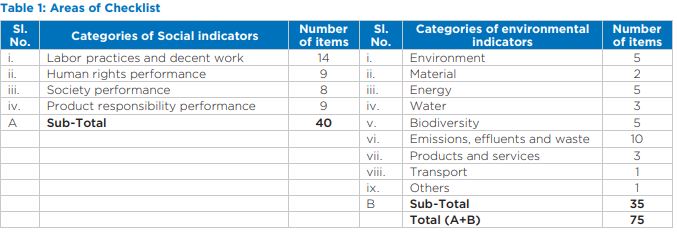
The study formulated checklist by considering Bangladesh perspective which were supportive of finding out existing image of CSER of the textile industry in Bangladesh. Areas of checklist (as the basis of GRI indicators) were given as follows:
Analysis and Findings of the Study
Content analysis was used to present the current practices of CSER disclosures of the textile industry. It was presented into the following 4 (four) sub-sections:
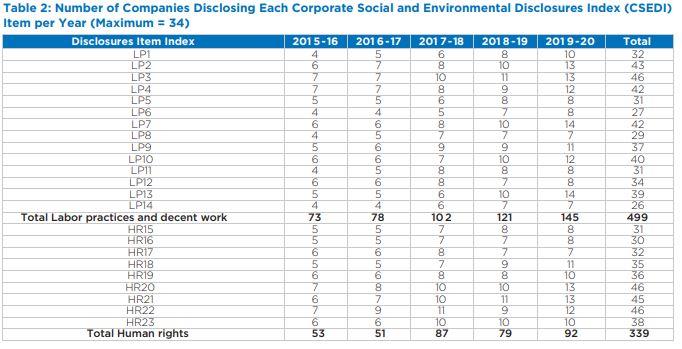
- Number of companies disclosing each CSER disclosures item per year;
- CSER disclosures by company (number of CSER practices);
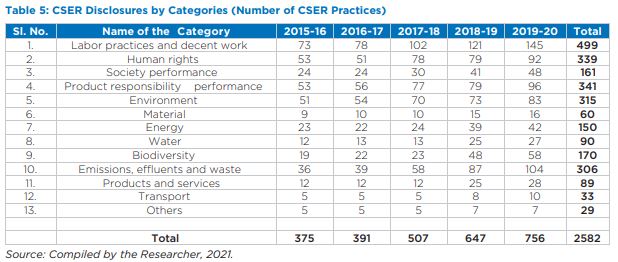
- CSER disclosures by category (number of CSER practices);
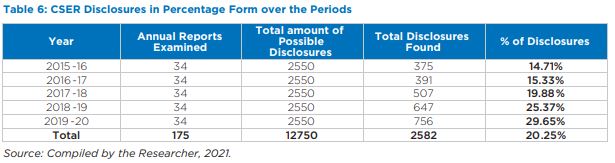
- CSER disclosures in percentages over the periods.
The result revealed that the social indicators (labor practices and decent work, Human rights and product responsibility) and environmental indicators (environment; and emissions, euents and waste) were greater complied rather than other environmental indicators (material, energy and water, biodiversity, etc.) of GRI guidelines. Again, number of companies disclosing each CSEDI item per year from 2015-16 to 2019-20 was increasing in pattern and the growth rate was very low and pessimistic i.e., about 25% to 30% in recent years.

The result found that CMC Kamal Textile Mills Ltd., Envoy Textiles Limited, Paramount Textile Limited and Square Textile Ltd. followed the highest (160 – 197) items of compliance of GRI guidelines. On the other hand, Argon Denims Limited, Dulamia Cotton Spinning Mills Ltd., Shasha Denims Limited and Tallu Spinning Mills Ltd.
GRI guidelines. The average number of CSER disclosures by the selected company was 120 – 137 items of compliance of GRI guidelines. So, it was concluded that the extent and frequency of CSER disclosures were not satisfactory.
The result showed that in the total number of CSER disclosures by categories, the social indicators (labor practices and decent work, human rights, society performance and product responsibility) and environmental indicators (environment; and emissions, euents and waste) were greater complied rather than other environmental indicators (material, energy and water, biodiversity, etc.) of GRI guidelines.
The result found that corporate social and environmental disclosures in percentage form over the periods of annual reports were also increasing in trends from 2015-16 to 2019-20. The growth rate was 20.25% on an average which was very low and not satisfactory.
Conclusion and Recommendations
In most of the countries in the world, corporate social and environmental reporting (CSER) is an emerging and dynamic field that can be considered work in progress. As a result, it is important to remember that the di‑erent streams of work that have greater or lesser emphasis on internal or external reporting, or private or external costs, are not mutually exclusive. Indeed, CSER can also be closely linked to other corporate social and environmental management initiatives. But, in Bangladesh, corporate social and environmental reporting can be considered at the infant stage. It is a common practice in the first world countries to account for and report social and environmental cost into the traditional accounting system.
However, companies of Bangladesh still lag behind when it comes to adoption of corporate social and environmental reporting into their traditional accounting system.
The current study is conducted to evaluate the prevailing practices of corporate social and environmental reporting (CSER) in the textile industry in Bangladesh. Using content analysis, the study has found that the extent and frequency of CSER disclosures are very low and unsatisfactory. It is encouraging to note that a developing country such as Bangladesh is making e‑orts to experiment with this new area of corporate reporting. There is room for improvements in corporate social and environmental reporting (CSER). Government and other regulatory bodies should formulate and implement mandatory guidelines regarding CSER reporting in Bangladesh in order to improve the CSER reporting in the selected industry. Comprehensive studies are necessary to draw valid conclusions about the underlying trends and techniques of CSER reporting in Bangladesh which may be considered worth-while and needs urgent attention of future research avenues.
References
Anderson, R. 1996. Multi-variate Data Analysis (4th edition). Upper Saddle River, New Jersey. Prentice Hall. Ali, M. M., Rashid, M. M. and Islam, M. A. 2010. Environmental Accounting and Its Applicability in Bangladesh, ASA University Review, Volume 4, Issue 1: 23-37.
Bala, S. K. and Yusuf, M. A. 2003. Corporate Environmental Reporting in Bangladesh: A Study of Listed Public Limited Companies, Dhaka University Journal of Business Studies, 24(1): 31-45.
Bose, S. 2006. Environmental Accounting & Reporting in Fossil Fuel Sector-A study on Bangladesh Oil, Gas and Mineral Corporation (Petrobangla). The Cost & Management, 34(2): 53-67.
Brammer, S. and Pavelin, S. 2004. Voluntary social disclosures by large UK companies, Business Ethics: A
European Review, Wiley Online Library, Volume 13, Numbers 2/3: 86-99.
Cecil, L. 2008. Corporate Social Responsibility Reporting in the United States, McNair Scholars Research Journal, Volume 1, Issue 1, Article 6: 43-52.
Chauhan, S. and Amit (2014). A relational study of firm’s characteristics and CSR expenditure, Symbiosis Institute of Management Studies Annual Research Conference (SIMSARC13), Procedia – Economics and Finance, Elsevier Ltd. 11: 23-32.
Crinis, V. 2019. Corporate Social Responsibility, Human Rights and Clothing Workers in Bangladesh and Malaysia. Asian Studies Review, 43(2): 295-312.
Dedman, E., Lin, S., Prakash, A. and Chang C. 2008. Voluntary disclosure and its impact on share prices: Evidence from the UK biotechnology sector. Journal of Accounting and Public Policy, 27: 195–216.
Hsu, F. 2018. Does Corporate Social Responsibility Extend firm Life Cycles?. Management Decision, Vol. 56, No. 11: 2408-2436.
Hughes, S. B., Anderson, A. and Golden, C. S. 2001. Corporate environmental disclosures: are they useful in determining environmental performance, Journal of Accounting & Public Policy, Elsevier Ltd., Volume 20, Issue 3: 217‐240.
Islam, M. A., and Deegan, C. 2008. Motivations for an organization within a developing country to report social responsibility information: Evidence from Bangladesh. Accounting, Auditing & Accountability Journal, Volume 21, Issue 6: 850-874.
Jain, A., Keneley, M. and Thomson, D. 2015. Voluntary CSR disclosure works! Evidence from Asia-Pacific banks, Social Responsibility Journal, Vol. 11 Issue 1: 2-18, Emerald Publishing L t d . http://dx.doi.org/10.1108/SRJ-10 -2012-0136
Marimon, F., Alonso-Almedia, M., and Rodriguez, M. 2012. The worldwide di‑usion of the global reporting initiative: what is the point?, Journal of Cleaner Production, 33: 132-144.
Naser, K. and Hassan, Y. 2013. Determinants of Corporate Social Responsibility Reporting: Evidence from an Emerging Economy. Journal of Contemporary Issues in Business Research, Volume 2, Issue 3: 56-74.
Neu, D., Warsame, H. and Pedwell., K. 1998. Managing Public impression; environmental disclosure in annual reports. Accounting, Organization and Society, Elsevier Ltd., 23(3): 251-295.
Noronha, C., Tou, S., Cynthia, M. I., and Guan, J. J. 2012. Corporate social responsibility reporting in China: An overview and comparison with major trends, Corporate Social responsibility and Environmental Management. http://dx.doi.org/10.1002/csr.1276
Rahman, M. A. and Muttakin, M. B. 2005. Corporate Environmental Reporting Practices in Bangladesh-A Study of Some Selected Companies, the Cost & Management, 33(4):13-21. Roca, L. C. and Searcy, C. 2012. An analysis of indicators disclosed in corporate sustainability reports, Journal of Cleaner Production, 20: 103-118. Rowe, M. 2006. “Reputation relationships and risk: A CSR primer for ethics officers”, Business and Society Review, 111(4): 441-455.