


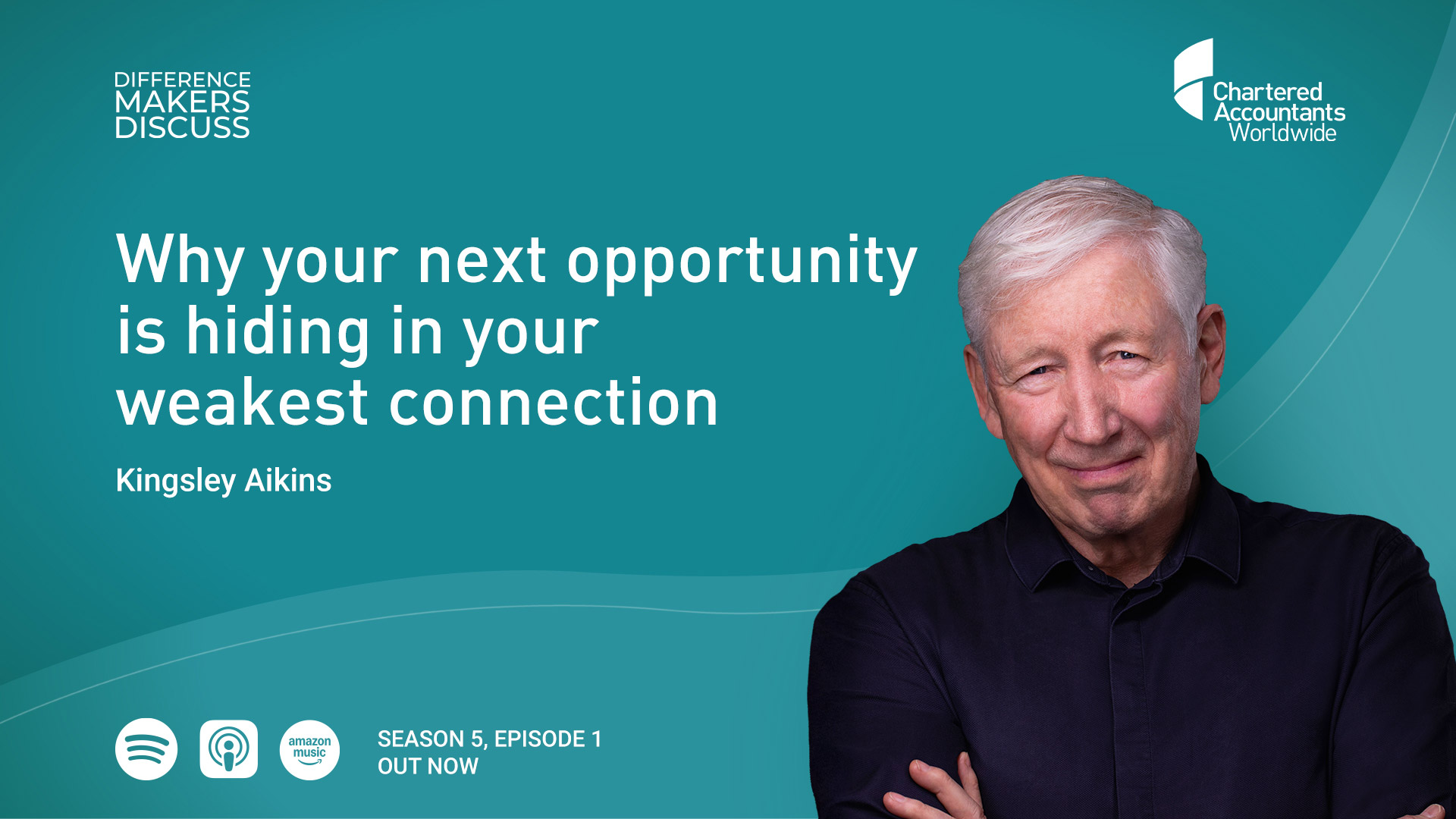
Ask most people to describe their network and they will describe their friends, their family and a handful of close colleagues. Kingsley Aikins calls that the inner concentric ring, and he argues it is the least useful part of your network. The opportunities sit further out, among the loose associations and the people you have not spoken to in three years.
In this episode, Kingsley joins host Sinead Donovan to continue their conversation on networking and to widen it out to something much bigger. There are now 305 million people living outside the country they were born in, roughly double the figure in 1970. Kingsley has written diaspora strategies for national governments, for regions and for cities, and he explains why so many of them have come round to seeing the people who left as national assets rather than lost actors.
Along the way he makes the case that networking is neither an art nor a science, but a process, and one that can be learned. He sets out what companies quietly lost when their networks shrank during the pandemic, why the technical skills that won you your first job matter less as you rise, and the practical tricks that make walking into a room full of strangers survivable.
What you will take away
- Why weak ties and loose associations are where opportunity actually sits, and how to rebuild an outer network that has quietly shrunk
- The five challenges bringing companies to his door: less business development, less learning on the job, less serendipity, thinner loyalty and weaker culture
- Practical techniques for working a room, from why you should look for ones and twos rather than groups, to the quiet usefulness of standing near the bar
- What the global diaspora phenomenon means for countries, regions and cities, and why around 120 countries are now building strategies around it
- The four fundamentals of a network: personal, strategic, operational and online
- Why the skills that earn you a job early in your career are not the ones that carry you later
About Kingsley Aikins
Kingsley Aikins is founder of Diaspora Matters, and an author and speaker on networking, philanthropy and diaspora engagement. He has written diaspora strategies for national governments and for regions and cities including Copenhagen and Cornwall, and works with corporates and chief executives on building networking capability across their organisations.
He spent much of his career in international philanthropy and fundraising, building events and networks across the United States and Australia, and he draws on that experience when he talks about the discipline of giving.